As described in our Project Aim, we are seeking effects that support teachers and AI educational systems in leveraging their own strengths and overcoming their independent weaknesses. As a result of this search, we expect to revise guidelines for AI-ED developers, give recommendations for teacher practices, and provide professional development in the context of AI. Furthermore, we believe these findings enable us to support the development of teacher AI policies and inspire policymakers. To achieve this, we examine throughout the project 6 different hybrid intelligent educational systems.
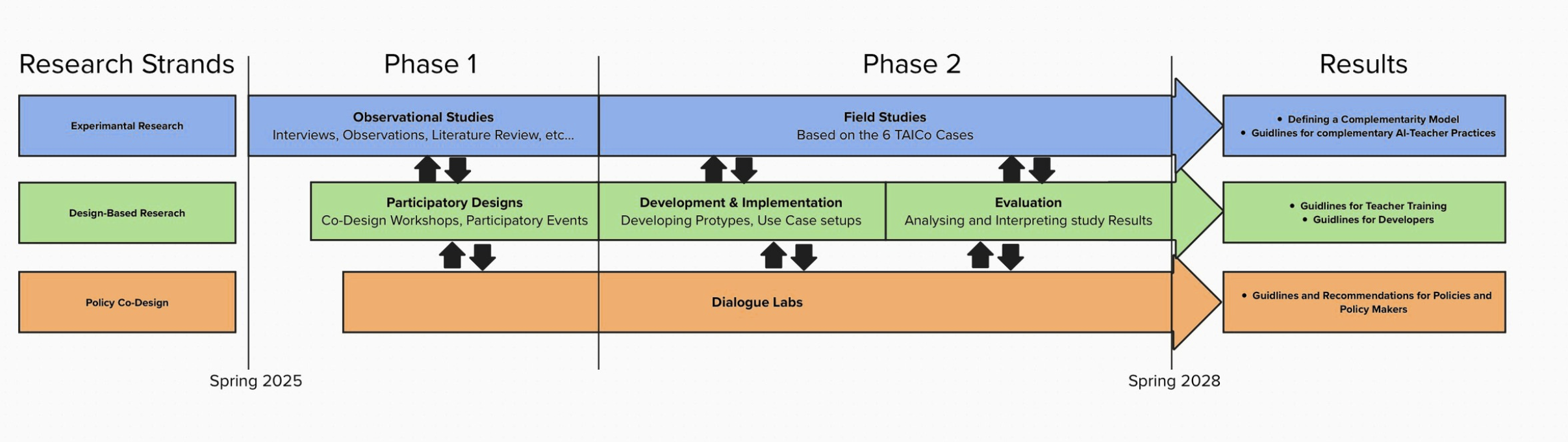
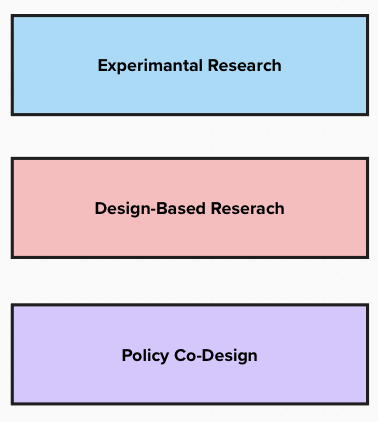
Experimental Research: Within observation and field studies, each Taico case conducts experiments to identify effects that support teacher AI complementarity, mainly from a technological perspective.
Design-Based Research: We follow with this research strand an iterative approach to identify effects that support teacher AI complementarity based on set interventions, interviews, and observations mainly from the teacher perspective.
Policy Co-Design: Throughout the whole project, we open our discourse in public events (e.g., Dialogue Labs), in which we reflect on our intermediate results, also in regard to ethical considerations, gender dimensions, and inclusivity.
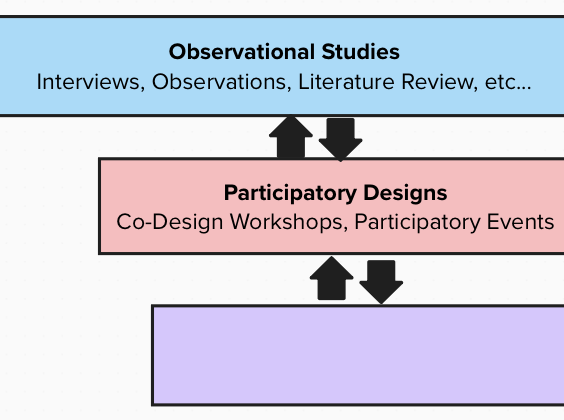
Observation Studies
Participatory Designs
Dialogue Lab
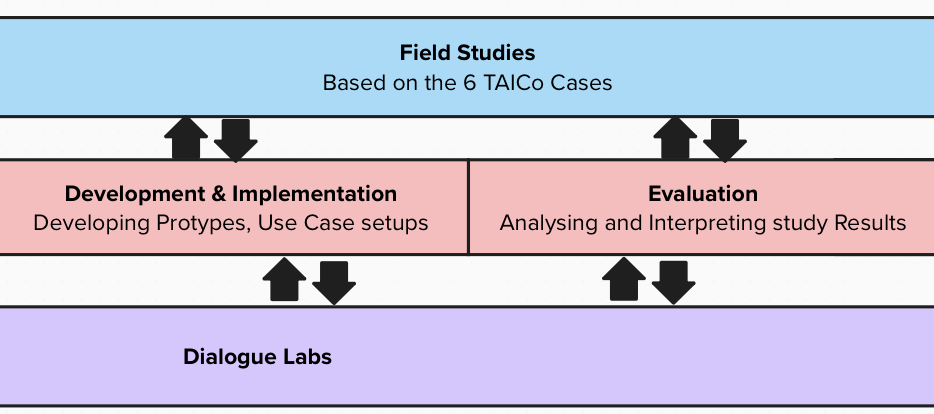
Field Studies
Development & Implementation of Prototypes
Evaluation of Prototypes
Further Dialogue Labs
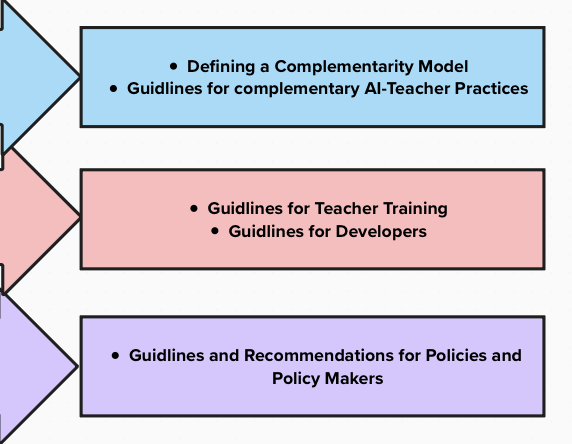
A Model that describes teacher AI Complementarity
Guidelines for complementary AI-Teacher Practices Guidelines for future Research and Development Projects
Guidelines and Recommendations for Policies and Policy Makers

Funded by the European Union. Views and opinions expressed are however those of the author(s) only and do not necessarily reflect those of the European Union or the European Research Executive Agency (REA). Neither the European Union nor the granting authority can be held responsible for them. Project Number: 101177268
University for Continuing Education Krems