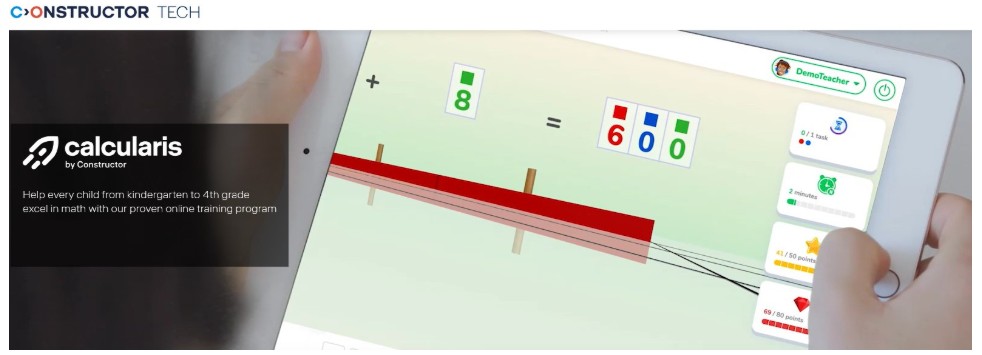
The case aims to gain a better understanding of how teachers can be effectively supported in their diagnostic decision-making while students learn math with an ITS. We investigate how teachers perceive and interpret information about students’ learning progress, performance, and behavior provided by the system. Through this analysis we gain understanding of teachers practices and needs, improving their decision making and thereby supporting student learning as well.
The dashboard component of an ITS displays and draws attention to student data, for example through visual cues such as color-coded symbols that draw attention to students who may need support. It enables teachers to intervene just-in-time, for instance by communicating with students or initiating adaptive instructional support.
The dashboard helps teachers support each student individually while reducing their workload. Teachers’ feedback helps improving the system, while the dashboard supports their professional development by introducing new methods into their practice.
As teachers manage a classroom and support students' learning, they face many challenges including supporting students with diverse learning needs as well as performance differences. With an ITS being able to assess students' progress as they solve mathematical tasks, a teacher-facing dashboard allows teachers to track learning progressions of individual students and alerts teachers to struggling students. The information provided from the dashboard complements teachers’ own observations and supports informed decision-making about when and how to intervene, for example by offering scaffolds or hints. This combination of teacher judgment and data-driven insight is key to delivering effective adaptive instruction.
Implementing and studying AI-based tools such as Intelligent Tutoring Systems (ITS) in real classroom contexts offers valuable opportunities to design solutions that are both effective and practically relevant. Working with young learners requires careful handling of student data and attention to data protection and privacy. Addressing these issues supports the development of responsible and trustworthy systems that follow ethical standards.
Conducting research in authentic classroom environments provides valuable insights into how AI-based systems are implemented under real classroom conditions. While these settings are naturally dynamic and less controlled than laboratory contexts, they offer a strong foundation for gaining insights and developing solutions that are robust and applicable in everyday teaching practice.
Ensuring teacher acceptance and effective use is equally important. Designing intuitive tools that integrate smoothly into existing teaching practices, alongside supporting teachers in interpreting and acting on learning data, helps ensure that the system meaningfully enhances instructional decision-making and student support.


Funded by the European Union. Views and opinions expressed are however those of the author(s) only and do not necessarily reflect those of the European Union or the European Research Executive Agency (REA). Neither the European Union nor the granting authority can be held responsible for them. Project Number: 101177268
University for Continuing Education Krems